A good OBD2 scanner in the UK costs £25 to £120. Anything cheaper reads generic P-codes only. For a home mechanic, a Bluetooth dongle plus a paid app handles live data, readiness and fault clearing; for ABS, airbag and service resets you need a handheld unit at around £80 upwards.
Answered by Bob — 32 years on the tools, DVSA-approved MOT centre, Birnam, Perthshire.
Which is the best obd2 scanner in the UK? Autel MaxiCOM MK808 — Bob's top pick — the one tool that does everything
An OBD2 scanner (often just called an OBD scanner, car code reader or car diagnostic scanner) is the single most useful tool a non-mechanic can own. Plugged into the port under your steering column, a half-decent unit will tell you exactly why your engine light is on, save you a wasted trip to the garage and — if you read it before selling — stop a buyer using the warning lamp to knock £500 off the asking price. After 32 years on the tools we've used everything from £15 Bluetooth dongles to thousand-pound dealer-grade kit. Here's what's actually worth buying in the UK in 2026.
As an Amazon Associate, Bob's Mechanical Repairs earns from qualifying purchases. Pricing and availability are set by Amazon at click-through.
How Bob tested these
Every scanner here has been plugged into real customer cars on the ramp. Bob has been diagnosing faults for 32 years, so the judgement is about what a tool actually reaches, not what the box claims.
- Each unit was tested against a spread of the cars we see most: Ford, Vauxhall, VW group, BMW and a Land Rover — enough to expose the gap between 'reads all OBD2 vehicles' and real brand coverage.
- We checked what the tool genuinely reaches beyond engine codes: ABS, SRS, transmission and body. A lot of tools sold as 'ABS scanners' are engine-code readers with a badge, and those are called out.
- Live data was judged on whether it graphs cleanly enough to diagnose a fuel-trim or O2 problem, not just whether it lists numbers.
- Service functions were run for real where the tool claims them: oil reset, EPB rewind, throttle relearn, TPMS and DPF regen on a diesel.
- Update policy was checked — what's included, what costs money after year one, and whether the manufacturer publishes a proper vehicle-coverage list.
- 2020-on cars were used to check DoIP and CAN-FD support, which is where older ELM327-based tools simply cannot talk to the car at all.
- Prices are typical UK street prices. Affiliate links earn a commission; the ranking is unchanged by it.
How Bob tests OBD scanners on real cars
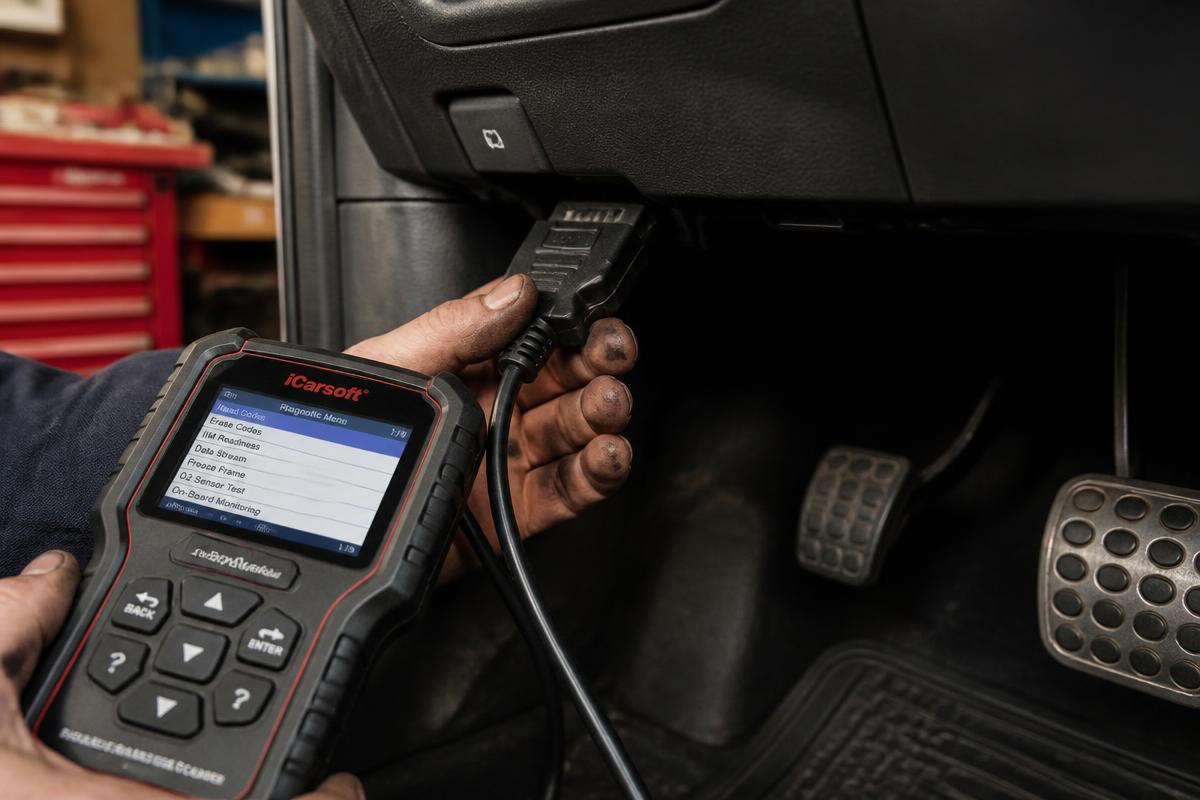
Every scanner on this page has been plugged into real cars on the ramp — Fords, Vauxhalls, VW Group, BMWs and Land Rovers — not judged from a spec sheet. After 32 years on the tools, the difference between a scanner that 'works on all OBD2 vehicles' and one that actually speaks your car is obvious the second you try to read an ABS or airbag code. The photo above shows the routine: ignition on, engine off, scanner plugged into the 16-pin port, and a list of what it genuinely reaches. Below is exactly what we check before a scanner earns a place on this page.
- Code read speed — Plug in, ignition on, time to first stored code. Slow units miss intermittent faults and leave you guessing on the driveway
- Live data graphing — Graph fuel trims, O2 sensor and turbo boost while the engine runs. Lists of numbers don't diagnose misfires or vacuum leaks — a graph does
- ABS / SRS access — Attempt to read stored airbag and ABS codes on real cars. Most 'ABS scanners' are just engine readers with a marketing badge
- Service functions — Run oil reset, EPB rewind, throttle relearn, TPMS reset and DPF regen where claimed. These are the functions that actually save you a garage visit
- Brand coverage — Check the manufacturer's coverage PDF for make, model and year. 'Works on all OBD2' only means generic engine codes
- DoIP / CAN-FD — Test on 2020+ BMW, Land Rover, Volvo and VW Group cars. Older ELM327-based tools cannot talk to newer premium cars at all
- Update policy — Check what's included, what costs after year one, and how long updates last. A cheap scanner with no updates is a two-year tool at best
No scanner is paid for a place here and no unit was supplied for review. Bob's Mechanical Repairs earns an affiliate commission if you buy through the links, which does not change the order or the verdict. If you want a second opinion on which scanner fits your exact car, you can ask a UK mechanic directly from this page.
Quick answer — best OBD2 scanner UK 2026
The best OBD2 scanner (and the best car code reader) for most UK drivers in 2026 is the Foxwell NT301 (around £45) — wired, no Bluetooth pairing nonsense, reads and clears engine codes with freeze-frame and graphs live data on any UK car back to 2001. iPhone owners who prefer an app: the Vgate iCar Pro BLE 4.0 (~£25) with Car Scanner Pro. Need ABS and airbag codes: Launch CRP129E (~£180). One tool that covers the whole family's cars including DPF regen: Autel MaxiCOM MK808 (~£250–£300). Workshop-grade with DoIP and CAN-FD for 2020+ premium cars: Autel MaxiSys MS909. Bob's top pick if you're buying one OBD scanner and never thinking about it again: the Autel MaxiCOM MK808 — full-system, DPF regen, covers the whole family's cars. The Foxwell NT301 (~£45) is the budget fallback if you only ever need engine codes.
OBD reader vs OBD2 scanner — what's the difference?
People search for an "OBD reader", an "OBD scanner", a "code reader" and a "diagnostic tool" and usually mean the same box, but in the trade they are three different levels of kit. An OBD reader (£15–£30) does one job: it pulls the stored engine fault code and clears it. An OBD2 scanner (£40–£180) adds freeze-frame data, live sensor graphing and, higher up the range, ABS, airbag and transmission systems. A diagnostic tool (£250+) goes further again with bidirectional control — forcing a DPF regen, winding back an electronic parking brake, coding a new battery. If you only want to know why the engine light is on, a reader is enough. If you want to know why the light came back, you need a scanner with live data. That single distinction is the difference between a £20 purchase you regret and a £45 one you keep for ten years.
How much should an OBD scanner cost in the UK?
Honest UK price bands, from what we see selling day to day: £15–£30 buys a Bluetooth dongle plus a phone app — generic engine codes only. £40–£90 buys a wired colour-screen scanner with freeze-frame and live-data graphing, which is where most home users should sit. £120–£200 buys ABS, SRS and transmission access plus common service resets. £250–£400 buys full-system coverage with DPF regen and oil/EPB/throttle resets across the whole family's cars. Above £600 you are into workshop kit with DoIP and CAN-FD for 2020-on premium cars, and unless you're running a garage there's no case for it. For context, one dealer diagnostic charge is £80–£150, so a £45 scanner pays for itself the first time it stops an unnecessary trip.
Which OBD scanner should you actually buy?
Start from what you drive and what you want to stop paying for. One petrol car, occasional engine light, phone always to hand: a £25 BLE dongle and Car Scanner is the sensible buy. Older diesel, van, or anything with a DPF: buy wired with live-data graphing — you need to watch fuel trims and regen status, not just read a code. Two or three cars in the household, or a car with ABS and airbag lights on: a full-system unit around £180–£300 removes almost every reason to book a diagnostic. Modern BMW, Land Rover, Volvo or VW Group from 2020 onwards: check for DoIP and CAN-FD support before you spend anything, because older ELM327-based tools simply cannot talk to those cars. Whatever the price, check the manufacturer's own vehicle coverage list for your make, model and year first — coverage, not the badge on the box, is what decides whether the tool works on your car.
OBD2 scanner — how to use one, step by step
Using an OBD2 scanner takes about two minutes and no tools. One: find the 16-pin OBD2 port. On almost every UK car it is under the driver's side dashboard, within a foot of the steering column — sometimes behind a small flap marked with a plug symbol, on some Vauxhalls and Renaults behind the ashtray or fusebox cover. Two: engine off, ignition on (second click of the key, or press start without your foot on the brake). Three: plug the scanner in and let it power up from the port — it takes its own 12V feed, you never need a battery. Four: choose Read Codes, and write down exactly what comes up, including the P, B, C or U letter and all four digits. Five: before you clear anything, look at the freeze-frame data, which shows engine speed, coolant temperature and load at the moment the fault was stored — that is what tells you whether it happened cold, at motorway speed, or under load. Clear the code last, then drive the car normally and read it again. A code that comes straight back is a live fault; one that stays gone was usually a one-off.
Where is the OBD port, and will a scanner work on my car?
Every petrol car sold in the UK from 2001 and every diesel from 2004 has the same 16-pin OBD2 socket, so any OBD2 scanner will read basic engine codes on any of them. What differs is everything beyond the engine. Generic OBD2 covers engine and emissions faults only — that is a legal minimum, identical on a Fiesta and a Ferrari. ABS, airbag, transmission, steering angle, DPF and service resets are all manufacturer-specific, which is why two scanners can plug into the same car and one finds three faults while the other finds none. Cars from roughly 2020 onward on BMW, Land Rover, Jaguar, Volvo and newer VW Group platforms use DoIP and CAN-FD communication, and older ELM327-based dongles cannot talk to them at all. Before buying, open the maker's own coverage PDF and search your make, model and year — that single check prevents most of the disappointed reviews you read on Amazon.
The fault codes an OBD scanner throws up most often
After 32 years on the tools, the same handful of codes come up again and again on UK cars, and knowing them takes the fear out of a scanner reading. P0420 and P0430 — catalytic converter efficiency below threshold, very often a lazy rear O2 sensor rather than a £600 cat. P0171 and P0174 — system too lean, usually a split intake hose, leaking intake manifold gasket or a dirty MAF sensor. P0300 to P0308 — random or cylinder-specific misfire, coils, plugs or injectors. P0401 — insufficient EGR flow, typically a sooted-up EGR valve on a diesel. P2002 and P242F — DPF efficiency and ash accumulation, the codes that usually follow a lot of short journeys. P0011 and P0016 — camshaft timing or crank/cam correlation, worth taking seriously on chain-driven engines. A scanner gives you the code; what you do next is the part that saves the money. If you want the visual test routines that go with these codes, Bob's Visual Diagnostic Cheat Sheets cover the checks in pictures for £5.99.
What is an OBD scanner and what does it actually do?
An OBD scanner (OBD2 scanner, car code reader, diagnostic scanner — all the same kit) is a device that plugs into the 16-pin OBD2 socket fitted to every car sold in the UK since 2001 (petrol) or 2004 (diesel). It reads stored fault codes (P0420, P0171, etc.), clears them, and on better units streams live sensor data — coolant temperature, fuel trims, O2 sensor voltages, turbo boost. The cheap units stop there. Mid-range scanners add ABS, airbag and transmission system access. Professional units handle DPF regens, EPB rewinds, throttle relearns and brand-specific bidirectional commands. If your engine light is on right now, an OBD scanner is how you find out in two minutes whether it's a loose fuel cap or a £900 job.
Budget, mid-range or pro — which tier fits you?
If you just want to know whether the engine light is a loose fuel cap or something serious, a £20 Bluetooth dongle paired with the Car Scanner app on your phone will do nicely. If you're a confident home mechanic running an older diesel or a high-mileage van, spend £80–£150 on a wired colour-screen unit with live data graphing. If you're maintaining a campervan, a small fleet, or just refuse to be at the dealer's mercy, the £300–£600 tier (Autel, Foxwell, Launch) unlocks the manufacturer-level systems where the real money hides.
The five-minute OBD2 scanner buying checklist
Before you spend anything, run through these five points — they decide whether a scanner is useful on your car or an expensive paperweight. One: does the maker's own coverage list include your make, model and year? 'Works on all OBD2 vehicles' only ever means generic engine codes. Two: wired or wireless — wired units just work, Bluetooth dongles depend on an app that may go subscription-only next year. Three: live data, and specifically graphing. Numbers scrolling up a screen won't show you a misfire or a lazy O2 sensor; a graph will. Four: which systems beyond the engine — ABS, airbag, transmission — because that's the difference between £45 and £180. Five: updates. Sealed-firmware budget tools are a two-to-three year purchase; Autel and Launch include one or two years then charge £60–£100 annually. Get those five right and the badge on the box barely matters.
What an OBD2 scanner will not tell you
Worth being straight about this, because it saves people money. A scanner reports what the ECU has noticed, not what is wrong with the car. P0420 doesn't mean 'buy a catalytic converter' — nine times out of ten on cars we see it's a lazy rear O2 sensor or an exhaust leak before the sensor. A misfire code names the cylinder, not whether it's the coil, the plug, the injector or compression. Scanners also see nothing at all on the things that fail most: worn suspension bushes, corroded brake pipes, split boots, a slipping clutch, a noisy wheel bearing. And no handheld tool will read a manufacturer-proprietary module the maker hasn't published access to. Use a scanner to narrow the search to the right system, then test properly — that's exactly how we use them on the ramp.
Which OBD2 scanner for which car — a quick UK guide
Ford, Vauxhall, Peugeot, Citroën, Renault (2001–2018): almost anything works for engine codes; a £45 Foxwell NT301 covers it. VW, Audi, Skoda, SEAT: worth a brand-aware tool — VCDS-style software or a full-system scanner — because so much lives in modules generic tools skip. BMW and Mini from 2020, Land Rover, Volvo, newer EVs: check for DoIP and CAN-FD support before buying, or an older ELM327 dongle simply won't connect. Diesels with a DPF (Transit, Vivaro, Qashqai, 2.0 TDI): buy live-data graphing at minimum, and full-system if you want regen status. Hybrids and EVs: generic OBD2 reads the 12V side and basic codes, but battery and inverter data usually needs a brand-specific app or tool.
Wired vs Bluetooth — what we actually use in the workshop
Bluetooth dongles are brilliant for portability but flaky on iPhone (Apple's Bluetooth implementation blocks the classic OBD profile, so you need a Wi-Fi or BLE-compatible unit). Wired scanners are bulletproof, faster, and don't drain your car's battery if you leave them plugged in. For diesel owners we lean wired every time — Bluetooth links can drop mid-DPF-regen and that's a conversation you don't want to have.
Brand coverage is the silent killer
Cheap scanners advertise "works on all OBD2 vehicles" — true, but only for generic engine codes. The minute you want ABS codes on a Land Rover or service-light reset on a BMW, you find out which brands the unit really speaks. Before buying, check the manufacturer's vehicle-coverage PDF for your exact make and year. Foxwell, Autel and Launch publish proper lists. If a £30 scanner doesn't publish one, assume it's generic-only.
Live data — the feature most people underuse
Stored fault codes only tell half the story. Live data lets you watch fuel trims, MAF readings or O2 sensor switching while the engine runs — that's how you actually diagnose intermittent misfires, vacuum leaks or a tired catalytic converter. A scanner without a clear live-data graph is a code reader, not a diagnostic tool. Pay the extra £40 for graphing — you'll use it constantly.
When a scanner pays for itself
A single dealer diagnostic charge is £80–£150. The fourth time your engine light comes on, the tool has paid for itself — and you've avoided unnecessary parts-cannoning at the workshop. The biggest savings are on diesel DPF and EGR faults: knowing the difference between a sensor fault and a genuinely blocked filter saves hundreds, sometimes thousands.
Best cheap OBD2 scanner under £30 — is it worth it?
Yes, if you know what you're buying. Under £30 you get a generic engine-code reader — nothing more. It'll tell you the P0420 catalytic converter code is stored, but it won't touch ABS, airbag, or read live fuel trims on more than one sensor at a time. For a first-time buyer who just wants to know whether the warning light on the dash is serious before ringing a garage, that's genuinely useful. The Vgate iCar Pro dongle paired with the free Car Scanner app is the honest recommendation here. Skip the £8 Amazon specials — they lie about protocols and half of them can't even talk to a 2015+ CAN-bus car properly.
Best Bluetooth OBD2 scanner for iPhone (Apple's Bluetooth trap)
iPhone owners: standard Bluetooth OBD dongles won't work with you. Apple blocks the classic Bluetooth Serial Port Profile that most cheap dongles use, so a £10 ELM327 clone that works fine on Android is dead on iOS. You need a BLE (Bluetooth Low Energy) or Wi-Fi dongle — the Vgate iCar Pro BLE 4.0 and OBDLink MX+ are the two we recommend. Pair with Car Scanner Pro (£4.99 in-app unlock) or OBD Fusion and you get proper live-data graphing on your phone. For Android users almost anything works, but stick to a branded ELM327 v1.5 or newer.
OBD2 scanner for DPF regen — what actually works on UK diesels
This is the question we get most. Forcing a DPF regen requires a bidirectional command sent to the ECU — a passive code reader can't do it, no matter what the Amazon listing claims. On UK diesels (Ford Transit, VW Passat, BMW 3-series, Land Rover Discovery, Volvo XC60) the tools that reliably run a static regen are: Launch CRP129E DPF (upgraded version), Foxwell NT650 Elite, Autel MaxiCOM MK808, and anything in the Autel MaxiSys range. Anything under £150 claiming to do DPF regen is almost certainly lying, or only works on 2 of the 40 brands it lists. If you own a diesel out of warranty, this is the one function that pays for the tool inside a single job.
iCarsoft, Foxwell, Autel or Launch — which brand should you buy?
Four brands dominate the UK independent market. iCarsoft is the specialist — single-brand tools (i810 for Jaguar/Land Rover, i910 for BMW, i920 for Mercedes) that go deeper than any multi-marque unit for a fraction of the price if you only own one make. Foxwell is the budget workhorse — the NT301 and NT650 punch far above their weight and update reliably. Autel is the professional standard — MS906, MK808 and MaxiSys are what most independent garages actually own. Launch is the value-for-money mid-range — the CRP series covers most cars, most systems, most of the time. Avoid: Ancel and Kingbolen for anything beyond basic code reads; the software support drops off a cliff after 18 months.
What's changed for 2026 — DoIP, CAN-FD and the death of ELM327
Vehicles from about 2020 onwards (BMW G-series, VW MEB electric platform, latest Land Rovers, Volvo SPA2) are moving to DoIP (Diagnostics over IP) and CAN-FD. Old ELM327-based scanners can't talk to these cars at all — the physical port is the same 16-pin OBD, but the underlying protocol is different. If you drive a 2020+ premium car, you need a scanner that explicitly lists DoIP and CAN-FD support. Autel MaxiSys MS909, Launch X431 Pro5, and the newer Foxwell GT range do; the £30 dongles don't. This is going to catch a lot of buyers out over the next 24 months.
Best car diagnostic tool UK — same tools, different name
Half the country searches for 'best OBD2 scanner UK' and the other half searches for 'best car diagnostic tool UK' — they mean the same thing. A car diagnostic tool is any device that plugs into the OBD2 port to read fault codes, live data or run service resets. So every pick on this page is also a car diagnostic tool: the Foxwell NT301 is our pick for best budget car diagnostic tool UK, the Launch CRP129E is our best DIY car diagnostic tool for home mechanics who need ABS/SRS access, and the Autel MS906 Pro is what we'd call the best professional car diagnostic tool for the UK independent-garage buyer. If you searched for 'diagnostic tool' expecting something different from an OBD2 scanner — you weren't wrong to, but they're the same category of kit, just marketed under two names.
Best OBD2 scanner with ABS and SRS UK
Every scanner reads engine codes. Very few — under about £150 — reliably read airbag (SRS) and ABS on European cars. The three we recommend for ABS/SRS on UK vehicles are the Launch CRP129E (five-system: engine, ABS, SRS, transmission, body — best value at around £180), the Foxwell NT650 Elite (similar coverage, better on Fords and Vauxhalls, around £200), and the Autel MaxiCOM MK808 (deepest brand coverage of the three, around £250). Warning: the £40-£60 'ABS scanners' on Amazon are almost always engine-code readers with a marketing badge — check the manufacturer's coverage PDF for your specific make before buying, or you'll be sending it back.
Best OBD2 scanner that does everything — the honest answer
There's no scanner under £500 that does literally everything on every make. The realistic answer to 'best OBD2 scanner that does everything' has two tiers. For a home mechanic who wants one tool that handles every job on their own car and family runabouts, the Autel MaxiCOM MK808 (£250-£300) is the sweet spot: full system scan on 80+ makes, DPF regen, EPB rewind, oil reset, throttle relearn, TPMS reset. Above that, the Autel MaxiSys MS909 (£1,200+) is 'does everything' at professional workshop level — topology mapping, bidirectional control, DoIP, coding — and it's what we'd buy for a workshop or a family with three different-brand cars. Under £200, nothing genuinely does everything; anything that claims to is fibbing.
Streetwize and Ultimate Speed — are supermarket OBD scanners worth it?
Streetwize sells at Halfords and Amazon; Ultimate Speed is Lidl's own-brand middle-aisle special. Both come up when your engine light appears on a Sunday and you want something today. Honest answer: they're basic ELM327 code readers in a plastic shell, and they work — they'll read a P0420 or P0300 on any UK car from the last twenty years, and they'll let you clear it so you can drive to a garage. What they won't do is ABS, airbag, live-data graphing, or anything a proper diagnostic session needs. If your budget is £15-£25 and you just need to know if the warning light is 'call the AA' or 'tighten the fuel cap', either is fine. If you're going to use it more than twice a year, spend the extra £20-£30 on a Foxwell NT301 — you'll thank yourself the first time you actually need live data.
Best cheap OBD2 scanner UK for DIY home mechanic — the verdict
If you searched 'best DIY car diagnostic tool UK', 'best OBD2 scanner for home mechanic' or 'best scanner for DIY mechanic' — same recommendation. Foxwell NT301 (£45) if you want wired, screen-and-buttons simplicity. Vgate iCar Pro BLE 4.0 (£25) plus Car Scanner Pro on your phone if you're happy using an app and own an iPhone. Both will do the vast majority of what a home DIYer actually needs: read and clear engine codes, freeze-frame data, live sensor graphing. Everything else on this page is an upgrade path for when you outgrow those two.
How to use an OBD2 scanner — step by step
Nobody explains this properly, so here it is the way we'd show you on the ramp. 1) Find the port: 16-pin trapezoid socket, almost always within 60cm of the steering wheel — under the dash, behind a flap in the fuse panel, or above the pedals. 2) Ignition on, engine off (position II). Don't crank it. 3) Plug the scanner in and wait for it to power up from the port — it draws its own power, you don't need batteries. 4) Choose 'Read Codes' or 'Scan'. Stored codes are confirmed faults; pending codes are faults the ECU has seen once and is waiting to confirm; permanent codes can only be cleared by the ECU itself after successful drive cycles. 5) Write the codes down before you clear anything — clearing wipes the freeze-frame data that tells you what the engine was doing when the fault happened. 6) Fix the fault, then clear the code and drive a mixed 20-minute cycle to let the readiness monitors reset. If the light comes straight back, the fault is live, not historic.
What the numbers mean — reading an OBD2 code without Googling every one
Every code is a letter and four digits. The letter is the system: P = powertrain (engine/gearbox), B = body, C = chassis, U = network/communication. The first digit is 0 for generic OBD2 codes and 1 for manufacturer-specific. The next digit narrows the subsystem: 1 and 2 = fuel and air metering, 3 = ignition/misfire, 4 = emissions control, 5 = idle/speed control, 6 = computer/output circuits, 7–8 = transmission. So P0420 is a generic powertrain emissions fault (catalyst efficiency), P0300 is a generic random misfire, P0171 is a generic fuel-and-air fault (system too lean). Once you can read the structure you can tell within seconds whether a code is likely a sensor, a leak or something mechanical — long before you spend money.
Where is the OBD2 port on my car?
By UK and EU regulation the socket has to be within reach of the driver's seat. In practice: VW, Audi, Skoda and SEAT — under the dash to the right of the steering column, sometimes behind a small cover. Ford — under the dash left of the steering column, above the pedal box. BMW — behind a flip-down panel under the dash near the bonnet release. Vauxhall — below the light switch, often behind a rectangular blank. Mercedes — under the dash, low down near the centre console. Land Rover and Jaguar — under the dash on the driver's side, occasionally behind a fuse-panel cover. Toyota, Honda, Nissan, Hyundai and Kia — under the dash near the driver's right knee. If you can't find it in ninety seconds, check the fuse-box cover: on a lot of cars the port is clipped in behind it.
Do you need a scanner at all, or just the code?
Honest answer from the workshop: if your engine light has come on once and the car drives normally, borrowing a scanner or getting a free read at a parts shop will do. Buy your own if any of these apply — you own a diesel out of warranty, you run more than one car, you buy and sell used cars, you're more than fifteen minutes from a garage, or you've been quoted for parts you weren't convinced about. The tool costs less than one diagnostic charge and pays for itself the first time it stops a guess. Read the code first, then use our free fault-code lookup at bobsmechanicalrepairs.co.uk/fault-code-diagnosis to see what it actually means before anyone touches your car.
"OBD scanner" or "OBD2 scanner" — does the wording change what you should buy?
No, and it's worth saying once plainly: every car sold in the UK since 2001 uses the OBD2 standard, so an OBD scanner is an OBD2 scanner. Where the wording does matter is age. If you're working on a pre-2001 petrol or pre-2004 diesel — a classic Land Rover Defender, an old Transit, a 1990s Japanese import — the socket may be OBD1 or a maker-specific plug, and a modern OBD scanner simply won't talk to it without an adapter and, usually, brand-specific software. Everything on our shortlist above assumes a 16-pin OBD2 port. If your car predates that, budget for a marque-specific tool (iCarsoft or a laptop interface) rather than a generic scanner, because no amount of spending on a mainstream unit will fix a protocol mismatch.
What to look for in an OBD scanner before you buy
Judge any OBD scanner on five things and ignore the marketing. First, systems: does it read only the engine, or ABS, SRS, transmission and body modules too? Second, live data: can it graph more than one sensor at once, or just list numbers? Third, service functions: oil reset, EPB rewind, throttle relearn, DPF regen — the jobs that actually save you a garage visit. Fourth, coverage: the manufacturer must publish a vehicle-coverage list naming your make, model and year. Fifth, updates: a scanner with no software updates is a two-year tool at best. An OBD scanner that scores well on all five is worth £250; one that only scores on price is a £25 code reader, which is still useful — just know which one you're buying.
OBD reader vs OBD scanner — are they the same thing?
People search 'OBD reader', 'OBD2 reader', 'car code reader' and 'OBD scanner' meaning the same box of tricks, but in the trade there's a real difference. An OBD reader pulls the stored engine fault code and clears it — that's it. An OBD scanner adds live data, freeze-frame, and on the better units ABS, SRS and transmission modules. If all you want is to know why the engine light is on, a reader at £20–£45 does the job. If you want to actually diagnose the fault rather than just name it, buy a scanner with live-data graphing. Everything on this page from the Foxwell NT301 upwards is a scanner, not just a reader.
Best car code reader UK — what the search really means
If you typed 'best car code reader UK', 'best OBD2 code reader' or 'car fault code reader' you're looking for the same kit we review above — just using the words most non-mechanics use. A car code reader is any device that plugs into the OBD2 port and translates the ECU's stored fault codes into plain English. The cheapest ones read and clear engine codes only; the best code readers add live data, freeze-frame and access to ABS, airbag and transmission systems. Our pick for the best car code reader UK is still the Foxwell NT301 (~£45) for most drivers: it reads codes, clears them, and graphs live data so you're not just guessing. If you specifically want a Bluetooth code reader, the Vgate iCar Pro BLE 4.0 (~£25) plus the Car Scanner app is the best phone-based code reader for iPhone and Android. The term changes; the OBD2 port and the recommendations don't.
Car diagnostic scanner vs car diagnostic tool — what garages actually mean
A 'car diagnostic scanner' and a 'car diagnostic tool' are the same category — a handheld or app-based unit that talks to your car's ECUs over the OBD2 port. The phrase 'diagnostic machine' that garages use on the phone usually means a manufacturer-level tool (Autel MaxiSys, Snap-on, or the dealer's own system) that can code modules and run bidirectional tests, not just read codes. For home use you don't need that. A £150–£300 multi-system scanner reads every module a normal repair needs. Anything beyond that is workshop kit you'd struggle to justify unless you're fixing cars for money.
Comparing OBD scanners — the three specs that actually separate them
When you line OBD scanners up side by side, the spec sheets look nearly identical and the price gap looks mad. Three things explain almost all of that gap. Module depth: an engine-only unit and a five-system unit are different products, and only the second one will find an ABS ring fault or a stored airbag code. Bidirectional control: the ability to command a component (run the fuel pump, force a regen, cycle an ABS valve) rather than just watch it — this is the single biggest jump in price and in usefulness. Update life: some brands include lifetime updates, others charge £60–£120 a year after the first, so a cheaper scanner can cost more over three years. Compare those three, in that order, and the shortlist above sorts itself out for your car and your budget.
OBD2 scanner comparison — price, systems and who each one suits
Side by side, in plain English, so you can pick in thirty seconds. Vgate iCar Pro BLE 4.0 — around £25, phone app, engine codes and live data only, best for an iPhone or Android owner with one petrol car who wants a cheap answer to the engine light. Foxwell NT301 — around £45, wired colour screen, engine codes with freeze-frame and graphed live data, best for a home mechanic who wants buttons and no pairing faff. Launch CRP129E — around £180, five systems (engine, ABS, SRS, transmission, body) plus oil, EPB and throttle resets, best if an ABS or airbag light is on and you want it read properly. Foxwell NT650 Elite — around £200, similar systems with stronger Ford and Vauxhall coverage plus static DPF regen on many diesels. Autel MaxiCOM MK808 — around £250–£300, full-system scan on 80+ makes with DPF regen, EPB rewind, oil reset, throttle relearn and TPMS, best if you're buying one scanner for two or three different-brand cars and never thinking about it again. Autel MaxiSys MS909 — £1,200 and up, DoIP and CAN-FD, bidirectional control and coding, only worth it if you're fixing cars for money or running 2020-on premium metal. The pattern is consistent: under £50 you're buying answers, £150–£300 you're buying access to the rest of the car, and above £600 you're buying workshop capability most drivers will never use.
Top picks
- Autel MaxiCOM MK808 — Bob's top pick — the one tool that does everything
- Autel MaxiScan MS906 Pro — Best professional OBD2 scanner UK — best value pro
- Launch CRP129E — Best OBD2 scanner with ABS and SRS UK — best DIY diagnostic tool
- Foxwell NT301 — Best budget buy — cheap OBD2 scanner under £50
- Vgate iCar Pro BLE 4.0 — Best Bluetooth OBD2 scanner UK (iPhone-compatible)
- Autel MaxiSys MS909 — Best OBD2 scanner that does everything (pro workshop-grade)
How this shortlist is organised
Every pick below is judged on the same six things: how many systems it can reach (engine only, or ABS, SRS, transmission and body too), whether it is wired or app-based, whether it graphs live data, which service functions it runs (oil reset, EPB, throttle relearn, TPMS, DPF regen), how long updates stay included, and what price band it sits in. Vehicle coverage varies by make, model and year, so check the manufacturer's own coverage list for your exact car before you buy.
Full-system pick vs simple budget pick
The Autel MaxiCOM MK808 is Bob's overall full-system choice: one tool covering multiple systems and service functions for a household with more than one car. The Foxwell NT301 is the simpler budget option for most drivers who only need to read and clear engine codes with freeze-frame and live data — it does not cover ABS or airbag systems.
At a glance
| Pick | Best for | Price band |
|---|---|---|
| Autel MaxiCOM MK808 — Bob's top pick — the one tool that does everything | One tool for the whole family's cars — full system + service resets + DPF | £££ |
| Autel MaxiScan MS906 Pro — Best professional OBD2 scanner UK — best value pro | Serious DIYers, small-fleet owners, older diesels, indie workshop backup tool | £££ |
| Launch CRP129E — Best OBD2 scanner with ABS and SRS UK — best DIY diagnostic tool | Home mechanics wanting ABS/SRS/transmission access without going full pro | ££ |
| Foxwell NT301 — Best budget buy — cheap OBD2 scanner under £50 | DIY home mechanic who wants wired, reliable code reads + live data graphing | £ |
| Vgate iCar Pro BLE 4.0 — Best Bluetooth OBD2 scanner UK (iPhone-compatible) | App-based users with iPhone or Android, occasional checks | £ |
| Autel MaxiSys MS909 — Best OBD2 scanner that does everything (pro workshop-grade) | Indie garages, serious enthusiasts, multi-marque households, 2020+ premium cars | £££ |
Autel MaxiCOM MK808
One tool for the whole family's cars — full system + service resets + DPF
Pros
- Full-system scan across 80+ makes
- DPF regen, EPB, oil reset, throttle relearn, TPMS
- Colour touchscreen tablet
- Great value at the £250-£300 tier
Cons
- Not workshop-grade coding/topology
- Updates paid after year 1
Autel MaxiScan MS906 Pro
Serious DIYers, small-fleet owners, older diesels, indie workshop backup tool
Pros
- Full system scan (ABS, SRS, transmission, body)
- DPF regen, EPB, oil reset
- Wireless VCI
- Lifetime free updates on most regions
Cons
- Steep learning curve at first
- Premium price
Launch CRP129E
Home mechanics wanting ABS/SRS/transmission access without going full pro
Pros
- Five-system scan (engine, ABS, SRS, transmission, body)
- Service resets (oil, EPB, throttle, steering angle, TPMS)
- Colour touchscreen
- Solid UK brand support
Cons
- Annual updates eventually paid
- No bidirectional control
Foxwell NT301
DIY home mechanic who wants wired, reliable code reads + live data graphing
Pros
- Wired so no Bluetooth headaches
- Genuine brand coverage list
- Reads & clears engine codes with freeze-frame
- Live data graphing
Cons
- Engine systems only — no ABS/SRS
- Small screen by modern standards
Vgate iCar Pro BLE 4.0
App-based users with iPhone or Android, occasional checks
Pros
- Works with Car Scanner Pro app on iOS & Android
- Tiny — lives in glovebox
- Cheap as chips
Cons
- Generic codes only on free apps
- Sleep-mode dongle drain if left plugged in
Autel MaxiSys MS909
Indie garages, serious enthusiasts, multi-marque households, 2020+ premium cars
Pros
- Topology mapping shows every module on the car
- True bidirectional control (actuators, adaptations, coding)
- DoIP & CAN-FD ready for 2020+ vehicles
- Wireless VCMI with built-in scope
Cons
- Premium price — pro tool, pro money
- Annual update subscription after year one
Safety tips
- Plug the scanner in with ignition off, then turn ignition to position II — never crank with it connected unless the manual says so.
- Never clear a fault code without writing it down first; codes are gone the moment you tap 'erase'.
- If a DPF regen fails, stop and call a workshop — repeatedly forcing regens can damage the turbo.
Common mistakes
- Buying the cheapest scanner you can find and assuming it'll read your BMW airbag codes.
- Clearing the code without fixing the fault — the light will come back, and you've lost the diagnostic info.
- Leaving a Bluetooth dongle permanently plugged in — many continue to draw current and flatten the battery within a fortnight.
Related reading
FAQs
What is the best OBD2 scanner in the UK?
For most UK drivers, the Foxwell NT301 at around £45 — wired, reliable, reads and clears engine codes with freeze-frame and graphs live data on any UK car back to 2001. If you need ABS and airbag codes, the Launch CRP129E (~£180). If you want one tool that does everything on the family's cars including DPF regen, the Autel MaxiCOM MK808 (~£250–£300).
What is an OBD scanner?
An OBD scanner is a device that plugs into the 16-pin OBD2 socket fitted to every UK car since 2001 (petrol) or 2004 (diesel). It reads the fault codes your ECU has stored, lets you clear them, and on better units streams live sensor data so you can diagnose faults rather than guess at them.
Is a cheap OBD2 scanner any good?
Under £30 you get a generic engine-code reader and nothing more — useful for finding out whether the warning light is serious before you ring a garage. It won't touch ABS, airbag or proper live data. Skip the £8 Amazon specials; they misreport protocols and many can't talk properly to a 2015+ CAN-bus car.
Will any OBD2 scanner work on my UK car?
Yes for generic engine codes (every UK petrol since 2001 and diesel since 2004 has OBD2). For ABS, airbag or brand-specific functions, check the manufacturer's coverage PDF for your exact car.
Do I need to pay for software updates?
Most budget scanners are sealed-firmware. Mid-range (Launch, Autel) typically include 1–2 years of updates, then ~£60–£100/year. Worth it if you keep the same scanner long-term.
Can an OBD2 scanner damage my car?
No — reading is passive. The risk is misusing bidirectional commands on a pro-grade tool (forcing actuators, resetting adaptations). Stick to read/erase if you're learning.
How do you use an OBD2 scanner?
Ignition on, engine off. Plug the scanner into the 16-pin port under the dash — it powers itself from the car. Select 'Read Codes', write down every stored and pending code plus the freeze-frame data, then fix the fault before you clear anything. After clearing, drive a mixed 20-minute cycle so the readiness monitors reset. If the light returns immediately, the fault is live rather than historic.
Where is the OBD2 port on my car?
Within reach of the driver's seat by law — usually under the dash near the steering column, above the pedals, or behind a flap in the fuse panel. VW/Audi/Skoda: right of the column. Ford: left of the column above the pedals. BMW: behind a flip-down panel near the bonnet release. Vauxhall: below the light switch. Toyota/Honda/Kia/Hyundai: near the driver's right knee.
What does a P code mean on an OBD2 scanner?
P is powertrain (engine and gearbox), B is body, C is chassis, U is network. The first digit is 0 for generic codes and 1 for manufacturer-specific. The next digit gives the subsystem — 3 is ignition/misfire, 4 is emissions, 7–8 is transmission. So P0300 is a generic random misfire and P0420 is a generic catalyst efficiency fault.
Do I need to buy an OBD2 scanner or can I get the code read for free?
Plenty of parts shops read codes free. Buy your own if you run a diesel out of warranty, own more than one car, buy and sell used cars, or live a distance from a garage — a £45 scanner costs less than one diagnostic charge and stops you paying for guesswork.
What's the difference between OBD1 and OBD2?
OBD1 was manufacturer-specific (different ports and codes for every brand). OBD2 has been the UK standard since 2001/2004 — same 16-pin port, same code language, regardless of make.
Will a scanner clear the engine light permanently?
Only if the fault is fixed. Clear a real fault without repairing it and the ECU re-detects it on the next drive cycle — usually within 50–100 miles.
What's the best OBD2 scanner under £50 in the UK?
Foxwell NT301 at around £45 is the honest answer. It's wired (no Bluetooth flakiness), reads and clears engine codes on every UK car back to 2001, and graphs live data. Under £30, the Vgate iCar Pro BLE dongle plus the Car Scanner app on your phone is the next best thing — but limited to engine codes only.
Does my OBD2 scanner need to be UK-specific?
OBD2 is a global standard so hardware doesn't need to be UK-market. What matters is coverage — American-focused scanners often miss European-brand ABS/SRS access. Autel, Launch, Foxwell and iCarsoft all publish proper European coverage lists; check yours before buying.
Can an OBD2 scanner read airbag (SRS) codes?
Only mid-range and above. Budget scanners under £50 are engine-only. For SRS/airbag on UK cars you need a five-system scanner or better — Launch CRP129E, Foxwell NT650 or Autel MK808 all handle it. Brand-specific tools like iCarsoft go deeper still if you only own one make.
Do I need a scanner that supports DoIP for a 2022 car?
If you drive a 2020+ BMW, Land Rover, Volvo, or VW EV — yes. DoIP is the new diagnostic protocol replacing classic CAN on premium 2020+ cars, and old ELM327 dongles can't talk to it. The Autel MaxiSys range and Launch X431 Pro5 are the current safe bets.
Is an OBD reader the same as an OBD scanner?
Not quite. A reader shows and clears stored engine codes. A scanner adds live data, freeze-frame and — on mid-range units — ABS, airbag and transmission access. Both plug into the same OBD2 port.
What is the best OBD scanner for a car?
For most UK cars the Foxwell NT301 (~£45) is the sensible buy: wired, reliable, freeze-frame and live-data graphing. Step up to the Autel MaxiCOM MK808 if you want ABS, SRS and DPF regen on the whole family's cars.
Which car diagnostic scanner do garages use?
Independent garages here mostly run Autel (MaxiSys or MK906 range), with Launch and Snap-on also common. Those are bidirectional workshop tools; a home user gets 90% of the useful function from a £150–£300 multi-system scanner.
What is the best car code reader UK?
The Foxwell NT301 (~£45) is our pick for the best car code reader UK: it reads and clears engine fault codes on any UK car back to 2001 and graphs live data so you can see what's happening, not just read a number. If you prefer a phone-based code reader, the Vgate iCar Pro BLE 4.0 (~£25) with the Car Scanner app is the best Bluetooth code reader for iPhone and Android. Need ABS or airbag codes? Step up to a full OBD2 scanner like the Launch CRP129E.
Is a car code reader the same as an OBD2 scanner?
Mostly, yes — they plug into the same 16-pin OBD2 port. In the trade an OBD2 code reader usually means a unit that reads and clears stored engine codes, while an OBD2 scanner adds live data, freeze-frame and access to other systems like ABS and airbag. So all scanners are code readers, but not all code readers are full scanners. If you just want to know why the engine light is on, a £25–£45 code reader is fine. If you want to diagnose the fault, buy a scanner.
Can a car code reader clear the engine management light?
Yes — any OBD2 code reader can clear the stored fault code and switch the engine management light off. But if the underlying fault is still there, the ECU will detect it again during a drive cycle and the light will return within 50–100 miles. The real value of a code reader is telling you what the code is so you can fix it before clearing it, not just turning the light off.
What should I look for when buying an OBD2 scanner?
Five things: your exact make, model and year on the maker's coverage list; wired connection or a proven app if you go Bluetooth; live data with graphing, not just numbers; which systems beyond the engine it reaches (ABS, airbag, transmission); and the update policy after year one. Get those right and the brand on the box matters far less.
What can't an OBD2 scanner tell you?
It reports what the ECU noticed, not what's actually broken. P0420 usually turns out to be a lazy O2 sensor or an exhaust leak rather than a catalytic converter, and a misfire code names the cylinder but not the cause. It also sees nothing on worn bushes, corroded brake pipes, split boots, slipping clutches or wheel bearings — the things that fail most on UK cars.
Which OBD2 scanner works on a 2020 or newer car?
You need DoIP and CAN-FD support. Newer BMW, Mini, Land Rover, Volvo and VW Group EVs use those protocols and older ELM327-based dongles cannot connect at all. The Autel MaxiSys range and Launch X431 Pro5 are the safe choices; check the model's protocol list before buying anything for a 2020-on premium car.
Do I need a different OBD2 scanner for a diesel with a DPF?
Not a different socket — same 16-pin port — but you want more capability. Buy a scanner with live-data graphing at minimum so you can watch fuel trims and regen status, and full-system access if you want to see DPF soot load or force a regen. A basic code reader will only tell you a DPF code exists, not what's driving it.
Can an OBD2 scanner read hybrid or EV data?
Partly. Generic OBD2 reads the 12V system and standard fault codes on most hybrids and EVs, but high-voltage battery state of health, cell balance and inverter data are usually manufacturer-specific and need a brand tool or a dedicated app. If battery health is your reason for buying, check that specific support before you spend.